Tony's Interview Story to become a bonafied Dream Director
This post has been dedicated to my goals for this year and beyond for Apple Pie Ridge with focus on the SAMR model, but before I discuss the theory behind my thinking, I want to share a story. The story is not mine; it's of a classmate from George Mason University: Tony. Tony Keith is a PhD student in Educational Leadership who focuses his research on Spoken Word Poetry as a manner to help minority groups find platforms to preform and learn. He has also recently coauthored The Open Mic Night: Campus Programs that Champion College Student Voice and Engagement.
Yes, in elementary, students are not putting on their business suit attire and walking into the real world after 3 p.m. today, but how do we prepare them to compete in this new type of environment even at this age? When I first started to teach, I was told that I'm helping students prepare for jobs that don't exist yet, and whoever told me that was right! For example, in the Social Media market alone, LinkedIn states 57,096 jobs need fulfilled in the United States alone. In Washington DC area, that number is 2,832.
 One of my ideas to help students get prepared for their next steps is to use technology effectively in the classroom by creating project-based assignments. If we provide them with the tools to understand how the 5C's (communication, critical thinking, collaboration, cooperation, and creativity) works within the context of a project when utilizing technology, my hope is that they will be better prepared for their future, no matter where their next steps are taking them or what job industry takes hold. Nevertheless, this is not a small feat and will take a while to implement!
One day, however, Tony was late to class for good reason. He was interviewing to become a Chief Dream Director for an organization called The Future Project. That's right: I wrote Chief Dream Director...as a real title for a job. He will be helping the youth of Washington DC by leading a group of Dream Directors create and organize community events in connection with schools. What I found even more interesting than the job title though was the interview process. After two rounds of screening interviews, Tony sat in a room with three other candidates and they interviewed together for four hours. Each interviewee was given scenarios situated in real contexts and then had to pitch ideas to the group of fellow interviewees and the company interviewers. Yikes! That's high stakes!
How does Tony's story help us?
I don't know about you, but in almost every interview I had, I would be the only candidate in the room. Sure, I have had a few round three interviews that were performance based: teaching a class with students or school board members; however, I never had to face the other candidates in the same room answering the same questions at the same time. Nevertheless, now that I know companies are thinking outside of their interview boxes, I think, "How can we help our students learn how to think in this manner, even at the elementary level?"
Need a reality check on how fast our world is moving? The Did You Know video is one of my favorites to watch!
SAMR Model
One of my ideas to help students get prepared for their next steps is to use technology effectively in the classroom by creating project-based assignments. If we provide them with the tools to understand how the 5C's (communication, critical thinking, collaboration, cooperation, and creativity) works within the context of a project when utilizing technology, my hope is that they will be better prepared for their future, no matter where their next steps are taking them or what job industry takes hold. Nevertheless, this is not a small feat and will take a while to implement!
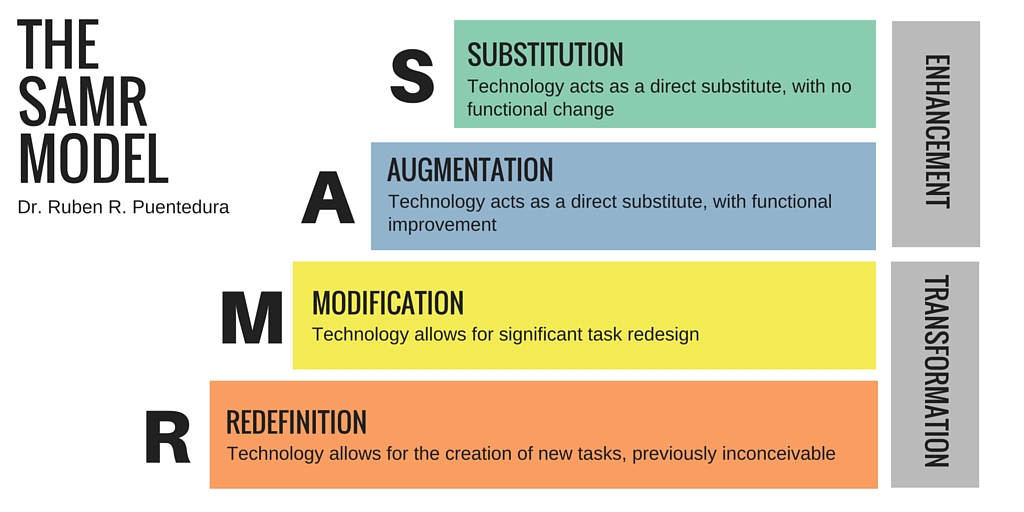
To begin on that road, I look to the SAMR model created by Dr. Ruben R. Puentedura. This model focuses on four steps: substitution, augmentation, modification, and redefinition. Given a one-to-one computer environment, a teacher generally starts using technology at the Substitution stage and then moves toward Redefinition of their teaching. However, every activity has an appropriate level due to your preferences and lesson vision. This year, I want to focus on Substitution and Augmentation stages of this model and work on helping you enhancing lessons. I'm excited to dig in more to learn how we can add to our instructional practices!
Comments
Post a Comment